20 to 45 MW per year
19 modules per hour, 7 operators, 550 m² floor space.
Technology · Hybrid PV-T
Photovoltaics and solar thermal in one module. The collector produces electricity and heat by day, stores the heat and keeps supplying at night without a battery bank.
The problem
Solar irradiance across the Middle East and North Africa is among the highest in the world. That is exactly where conventional solar farms lose output: heat lowers cell efficiency, dust settles on the modules, and power after sunset only comes with expensive batteries.
Concentrated solar power (CSP) partly solves storage, but only pays off above roughly 50 MW and depends on a few large turbines.
Comparison
| System | CAPEX per MW | Storage | LCOE per kWh | Land per MW |
|---|---|---|---|---|
| PV with battery | USD 6 to 7M | 12 h (battery) | 13 to 14 US¢ | 5 ha |
| CSP with thermal storage | USD 6 to 7M | 9 to 12 h | 9 to 10 US¢ | 6.5 ha |
| Hassabou PV-T | USD 5M | 24 h (heat) | 5 US¢ | 2.5 to 3 ha |
Source: ITC pilot plant and project documents, 2024. CSP covers parabolic troughs (about 600 °C) and solar towers (above 1,000 °C).
How it works
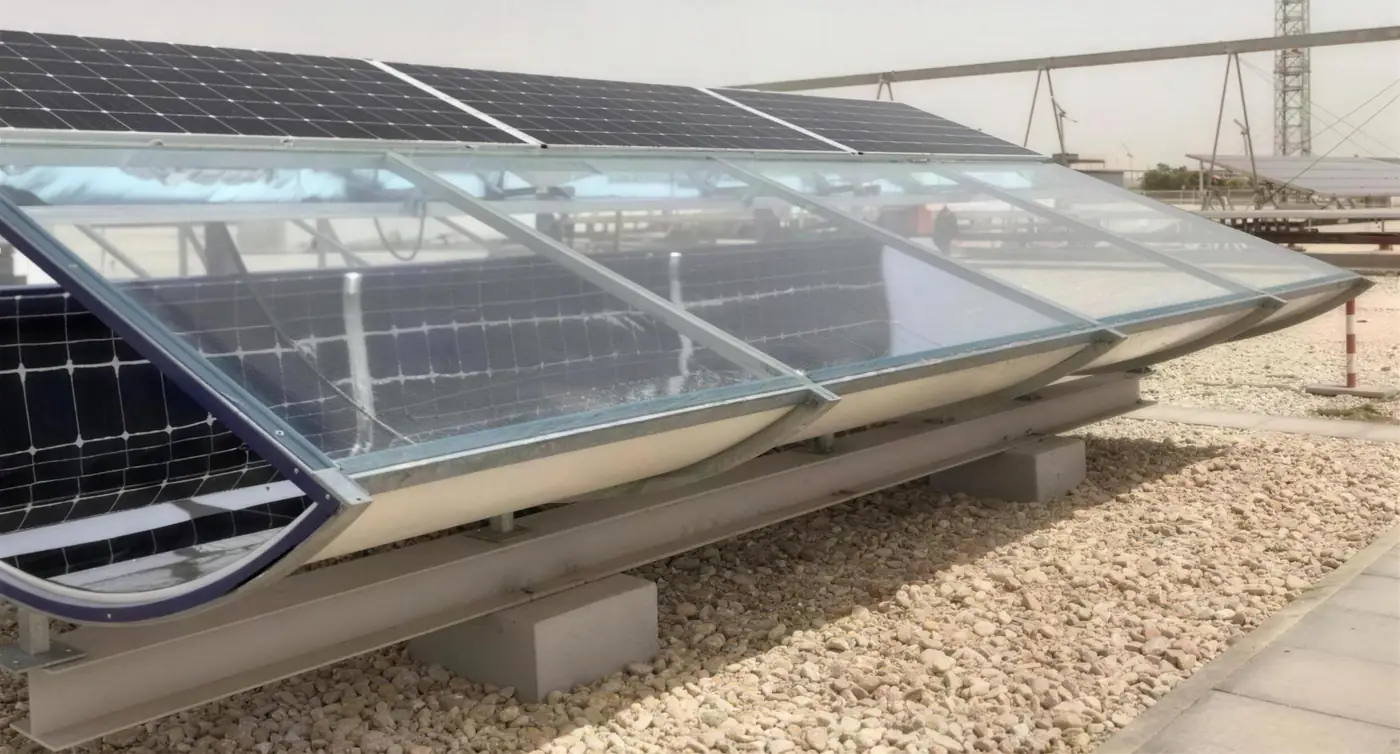
In the Hassabou collector, photovoltaic cells sit on a solar thermal absorber. The cells produce electricity. The absorber takes up the heat that normal modules waste, heat that would otherwise push the cells' temperature up.
That heat goes into thermal storage. From there the plant keeps supplying after sunset, as process heat, steam or electricity. The result is firm capacity over 24 hours, without a battery bank.
An automatic cleaning system keeps the glass cover free of dust. It saves water and prevents soiling losses.
Economics
Levelized cost over the full life of a plant. The PV-T collector matches hydropower, without needing a river or a dam.
| Technology | US cents per kWh | CAPEX/MW |
|---|---|---|
| Hassabou PV-T | 5 | $5M |
| Hydropower | 5 | $3.0M |
| New coal | 8 | $2.1 to 3.5M |
| New nuclear | 9 | $7.0M |
| CSP with storage | 9 to 10 | $6 to 7M |
| PV with 12 h battery | 13 to 14 | $6 to 7M |
Pilot plant
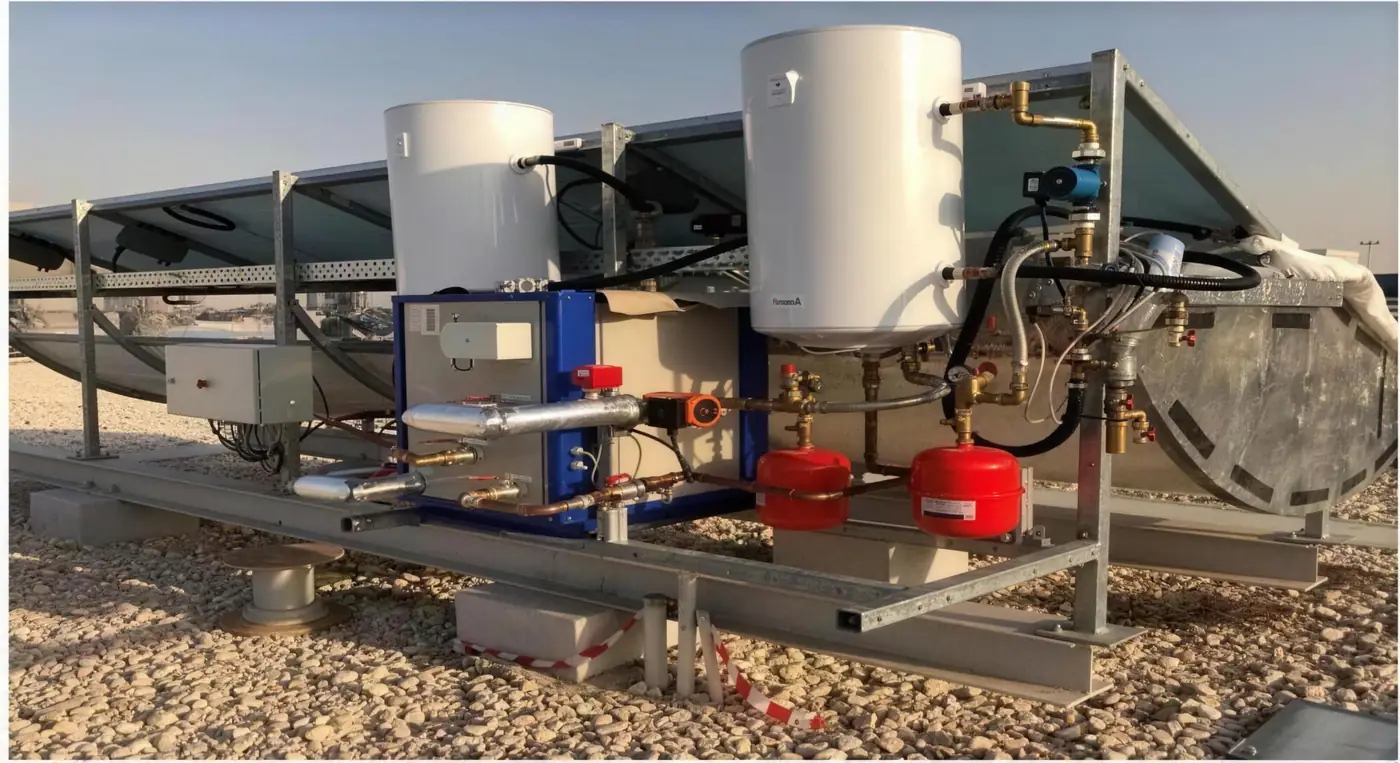
The figures on this page come from the Hassabou collector pilot plant: glass-covered collector rows, two thermal storage tanks, a heat exchanger skid, pumps and controls.
For feasibility studies, ITC scales these values to the actual site, based on direct normal irradiance (DNI), load profile and heat demand.
Local manufacturing
Together with Italian machine builder Ecoprogetti, ITC sources complete PV module production lines. Projects in MENA and the Gulf can build their modules locally, to European quality standards.
19 modules per hour, 7 operators, 550 m² floor space.
58 modules per hour, 9 operators.
58 modules per hour, 5 operators, 1,200 m² floor space.
116 modules per hour, 8 operators per shift, 2,000 m² floor space.
Manufacturer data, Ecoprogetti S.r.l.
Questions
A hybrid collector that combines photovoltaics and solar thermal. It produces electricity and usable heat from the same surface.
Heat collected during the day goes into thermal storage. The plant draws on that storage after sunset. No batteries are needed.
Pilot plant data puts the levelized cost at about 5 US cents per kWh, with an investment of about USD 5M per MW. For a specific project we calculate with the site data.
2.5 to 3 hectares per MW. That is about half of what PV with battery storage needs for the same output.
Wherever heat, steam or cooling is needed alongside electricity: oil recovery, desalination, agriculture, hydrogen and large sites such as airports.

Contact
Tell us about the site, the demand and the timeline. We'll come back with the right technology mix and the right partners.
Start a conversationITC GmbH, Berlin